This dark 1993 comedy by Nicky Silver, the play that first brought him wide recognition, has been revived off-off-Broadway in an earnest production by the Strain Theatre Company at Teatro Circulo. It provides an interesting opportunity to see an early version of the classic dysfunctional family Silver has written about as recently as The Lyons. The entire Duncan family of suburban Philadelphia is living in denial. Son Todd (Roger Manix), just returned home after five promiscuous years away, denies his mortality even though he has AIDS. His sister Emma (Lori Kee) is a hypochondriac whose severe memory problems keep her from facing her problems, which, it is strongly suggested, include sexual abuse by her father. The adulterous father Arthur (Dennis Gagomiros) is a bank president who confuses his own memories with his childrens’ and is too fond of his daughter. The mother Grace (Maggie Low) is an alcoholic who tries to find meaning in party planning, virtually indifferent to whether the event is her daughter’s wedding or her son’s funeral. Tommy McKorckle (Jeremiah Maestas), Emma’s fiance, is a sexually confused, orphaned homeless waiter whom Grace presses into service as the family maid. Silver’s blends the absurd, the lyrical, the shocking and, occasionally, the realistic. Navigating these rapid changes is a challenge that the actors meet with varying degrees of success. The looming dinosaur skeleton Todd is assembling from bones found in the backyard is a rather ponderous symbol of the family’s imminent extinction. I suspect that theatrical developments since 1993 have robbed the play of some of its shock value. Peri Grabin Leong’s living room set is quite attractive. Marisa Kaugars’s costumes are apt. Stephen Kaliski’s direction is a bit tentative. Running time: 2 hours, 5 minutes including intermission.
Sunday, July 27, 2014


Saturday, July 26, 2014
Between Riverside and Crazy ****
With his new play now in previews at the Atlantic Theater Company, Stephen Adly Guirgis proves once again that he is one of our most entertaining playwrights. Walter “Pops” Washington (the superb Stephen McKinley Henderson) is a black former cop whose career was ended by a hail of bullets in a dicey bar 8 years before the play opens. He has been recently widowed, his son Junior (Ray Anthony Thomas) has been in and out of jail and consorts with criminals such as Oswaldo (Victor Almanzar) who has moved in with them. Their household is completed by Lulu (Rosal Colon), Junior’s girlfriend, who has more curves than brains. We also meet Walter’s former partner Detective O’Connor (Elizabeth Canavan) and her fiance Lieutenant Caro (Michael Rispoli), an ambitious, politically well-connected cop. Last but not least is the Church Lady (Liza Colon-Zayas), a visitor who is not what she seems. Walter’s landlord is out to evict him from his rent-controlled apartment on Riverside Drive. Lt. Caro is determined to do whatever it takes to get Walter to sign a settlement with the city that he has been fighting for 8 years to remove loose ends in an election year and enhance his career. What makes the play so exciting is Guirgis’s dialogue. The language is rough, but the humor is wonderful. The play opens with a discussion of nutrition unlike any you are likely to hear again. Guirgis skillfully softens up the audience with humor so that when he turns serious, the impact is twice as strong. The first scene of the second act features the most bizarre sex scene I have seen on a stage — and there’s no nudity involved. The remainder of the second act was less successful and I found the ending weak. Nevertheless, everything else was so enjoyable that these defects barely diminished my pleasure. Walt Spangler’s revolving set captures the look of a grand apartment that had seen better days. Alexis Forte’s costumes suit their characters well. Austin Pendelton’s direction is assured. If you enjoyed “The Motherf**ker with The Hat,” you will love this one; if you didn’t, you probably won’t. Running time: 2 hours, 5 minutes including intermission.
Tuesday, July 1, 2014
The Lion ***
Benjamin Scheuer, the talented singer/songwriter who wrote this autobiographical one-man musical at Manhattan Theatre Club's Stage II, is a most appealing performer. With his mop of chestnut hair, open face, charming smile, strong voice and phenomenal guitar technique, he wins the audience over almost instantly. In this cycle of 15 songs lightly interspersed with conversational remarks, he charts the course of his life from the age of 8 when his father built him a toy banjo out of a cookie tin. The lifelong love of music his father instilled has served him well through a series of traumas that include losing his father when he was 14, being uprooted to England for the next four years, finding and losing love upon his return to New York, and suffering a near-fatal illness. How he finally resolved his conflicted feelings about his father and became his own man both personally and musically is a central theme. Neil Patel's simple set with two chairs, a table and seven guitars is sensitively lit by Ben Stanton. Sean Daniels's direction keeps things on an even keel, skillfully avoiding the maudlin or sentimental. The extravagant praise by the critics raised my expectations a little too high, but I nevertheless enjoyed the evening. The enthusiastic audience was much younger than the usual MTC demographic. Running time: 70 minutes, no intermission.
Thursday, June 26, 2014
Cabaret ***
Roundabout’s revival of the revival of this classic musical is mostly successful. The Sam Mendes/Rob Marshall production has lost little of its bite. Alan Cumming’s Emcee is as compelling a presence as ever. Bill Heck makes a fine Clifford Bradshaw. The ever-reliable Danny Burstein is a natural for Herr Schultz. Linda Emond is a revelation as Fraulein Schneider — who knew she had the vocal chops to go with her fine acting? Gayle Rankin and Aaron Krohn do right by the roles of Fraulein Kost and Ernst Ludwig. The talented (and beautiful!) Kit Kat Band once again plays Kander & Ebb's terrific score sensationally and the Kit Kat Girls and Boys are easy on the eyes and light on their feet. And then, alas, there’s Michelle Williams as Sally Bowles. I can’t explain precisely why she fails — her voice is not bad — but the role somehow seems beyond her expressive range. It doesn’t sink the show, but it definitely weakens its impact. Robert Brill’s set successfully turns Studio 54 into the Kit Kat Klub. The audience was wildly enthusiastic. Running time: 2 hours 30 minutes including intermission.
The Other Mozart ***
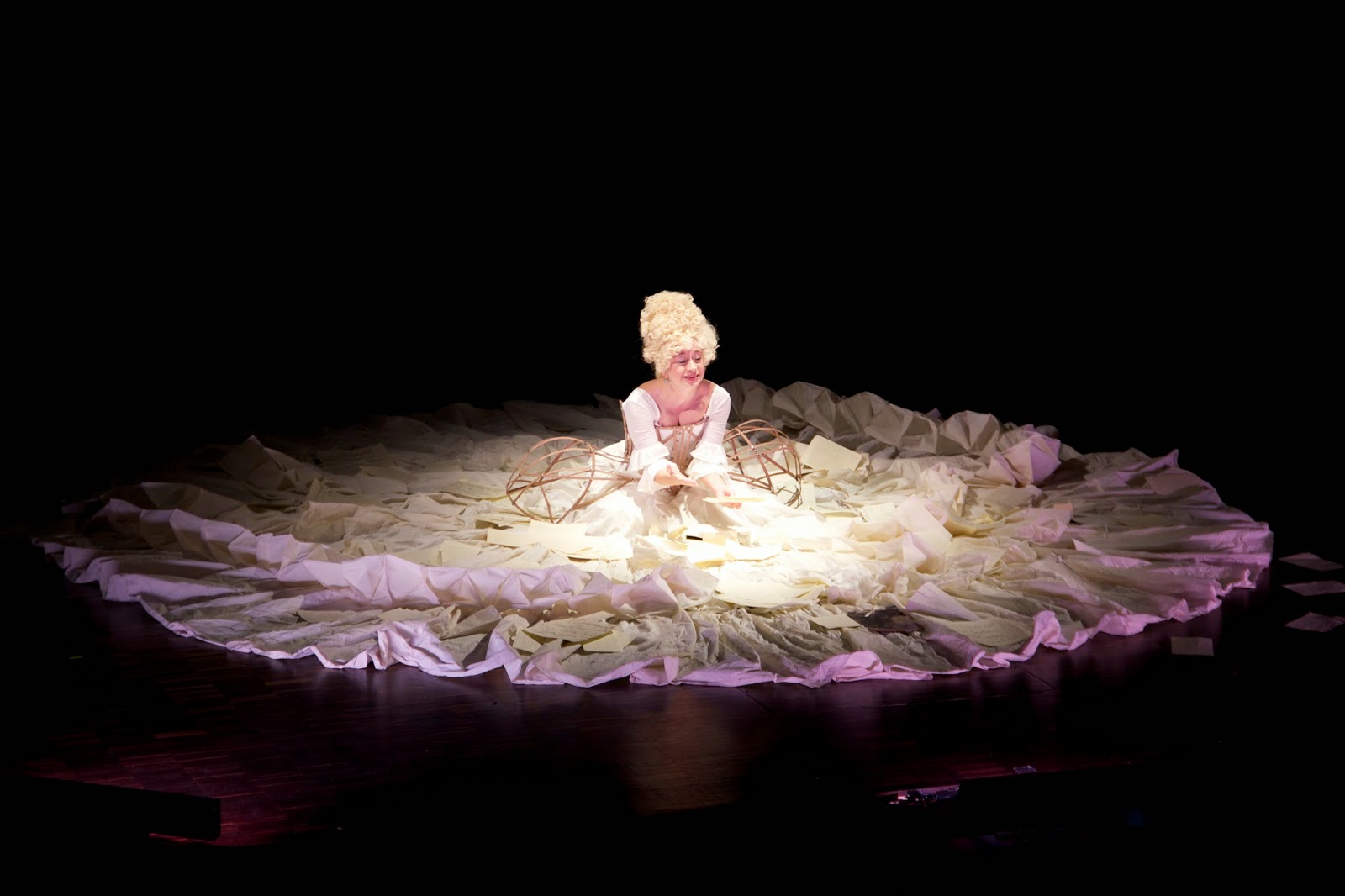
After earlier productions at Piccolo Spoleto, the Cherry Lane Theatre, the Berkshire Fringe and the Mozarteum in Salzburg, this solo piece written and performed by Sylvia Milo is now at the HERE Theater in SoHo. The title character is Marianne Mozart, nicknamed Nannerl, older than her brother Wolfgang by almost 5 years, and also a musical prodigy. Nannerl was a superb harpsichordist and, during their childhood concerts together, she was originally the main attraction. That soon changed. Since there was no career path available to a woman musician, father Leopold shifted all of his attention to Wolfgang. As Nannerl reached marriageable age, her parents encouraged her to devote all her time to learning the household skills that would please her future husband. Her musical career faded away. She was prevented from marrying the man she loved (for reasons not made clear) and, at 32, was wed to a widowed baron with five children and forced to live as a provincial housefrau. For mysterious reasons, she gave her infant son to her father to raise during his first two years. She lived until the age of 78. Her gravestone is inscribed “sister of Wolfgang Amadeus Mozart.” Milo tells this story, mostly in chronological order. She is skillful in portraying Nannerl at the various stages of her life, less so portraying other family members. Much of the text comes from family letters she saved. She observes sadly that no one saved her letters. Milo captures the conflicting feelings of love, devotion, admiration, resentment and jealousy Nannerl felt for her brother. Throughout the piece, we are presented with many (perhaps too many) examples of how her gender prevented her from having a satisfying, creative life. The production is visually striking. We see Nannerl in her bloomers, with a lofty coiffure (by Courtney Bednarowski), standing on a white dress that covers almost the entire stage with a pannier (by Miodrag Guberinic) in its center. The dress (by Magdalena Dabrowska) is covered with letters and musical scores and has hidden pockets out of which Nannerl pulls such objects as a miniature keyboard and a teacup. The play has background music by Mozart (father and son), supplemented by original music by Nathan Davis and Phyllis Chen. It made for an interesting 75 minutes, although I was left wishing there had been more biographical explication and less repetitiveness about how Nannerl suffered for her gender. Isaac Byrne directed.
Monday, June 23, 2014
Ayckbourn Ensemble ****
All praise to the folks at the Brits off Broadway festival at 59E59 Theater for bringing us three works by Alan Ayckbourn (two world premieres and a New York premiere) performed in repertory by a superb ensemble of 11 actors from the Stephen Joseph Theatre of Scarborough, the company that Ayckbourn directed for 37 years. I know that I have said on other occasions that playwrights should not direct their own plays, but I hereby make a notable exception for Ayckbourn. After working with a core of the same actors for many years, he knows how to get exactly the right tone from them. I have seen other productions that were marred by overemphatic acting either allowed or encouraged by their directors.
Farcicals ***
Realizing that only 7 of the 11 actors appeared in both the other plays, Ayckbourn whipped up a pair of one-act farces for the remaining four. “Chloe with Love” and “The Kidderminster Affair” share the same characters, two rather mismatched couples — Penny (Elizabeth Boag) and Reggie (Kim Wall) plus Teddy (Bill Champion) and Lottie (Sarah Stanley). The first shows Lottie’s hilarious attempts to stoke her husband’s interest. The latter describes a hysterical attempt to hide an adulterous indiscretion. Both are sheer froth, but the word play and physical humor in the second play rise to a high level of inspiration. Running time: 1 hour, 35 minutes including intermission.
Playing with time and space is a frequent feature of Ayckbourn’s work. We see it again here, both in “Time of My Life” from 1992 and “Arrivals and Departures,” his new play (#76).
We meet the Stratton family, parents Gerry (Russell Dixon) and Laura (Sarah Parks), their elder son Glyn (Richard Stacey) and his wife Stephanie (Emily Pithon), who have just recently reconciled after a separation, and their younger son Adam (James Powell) and his new girlfriend Maureen (Rachel Caffrey) as they gather at the family’s favorite restaurant, a vaguely Middle Eastern place, for a boozy celebration of Laura’s birthday. After the initial party scene, the play fractures into three strands: we follow Gerry and Laura as they remain at the restaurant, we move a year or two into the future with Glyn and Stephanie, and we go backwards in time with Adam and Maureen to their first meeting. All the action takes place in the restaurant. An added touch is that one actor (Ben Porter) plays the restaurant’s owner and all its diverse waiters. We end up where we started as the birthday party begins. It sounds gimmicky, but it works surprisingly well except for a scene in the second act that goes on much too long. The play’s theme seems to be “Gather ye rosebuds while ye may.” Running time: 2 hours, 35 minutes including intermission.
Arrivals and Departures ***
This new play is deliberately less comic than the others. It combines a satiric look at bureaucratic ineptitude with the recollections of two disparate characters, each of whom has been subject to betrayal. A military special forces group led by Quentin (Bill Champion) has concocted a hare-brained scheme to catch a terrorist at a rail terminal in London. Disguised as ordinary people, the group ineptly rehearse their roles before the train arrives. Ez, short for Esme, (Elizabeth Boag) a sullen soldier who is awaiting court martial, is assigned to babysit a chatty older man, Barry (Kim Wall), a traffic warden from Yorkshire who can possibly confirm the suspect’s identity. Awaiting the train’s arrival, Ez looks back on the personal history that has turned her into an edgy, mistrustful person. Much of the second act is a mirror image of the first, except that this time it is Barry who reminisces about his unhappy past. The plan to capture the terrorist does not end happily. I found the ending a bit jarring. Running time: 2 hours, 30 minutes including intermission.
The ensemble is so uniformly fine that it almost seems unfair to single out anyone. Nevertheless, I will mention that Boag, Champion, Parks, Porter and Wall made especially strong impressions. Jan Bee Brown's set designs for all three plays are simple but effective.
You may wonder why I rated Ayckbourn Ensemble higher than any of its components. In this case the whole IS greater than the sum of its parts. Seeing the three pieces together in one day increased my admiration of the playwright/director and the superb ensemble cast.
Sunday, June 15, 2014
The Who & the What ***
Winning the Pulitzer Prize for Drama must have put a lot of pressure on playwright Ayad Akhtar to come up with another play that is equally impressive. While his new play at LCT3 lacks the explosive power of “Disgraced,” it does have much to recommend it. Afzal (Bernard White) is a wealthy widowed Pakistani immigrant who has risen from cabdriver to owner of the largest taxi fleet in Atlanta. His two adult daughters are Zarina (Madine Malouf), a bookish, somewhat aloof Harvard grad who has been working on a novel for years, and Mahwish (Tala Ashe), her slightly flighty younger sister who would like to marry but cannot because tradition demands that the older daughter marry first. When Zarina wanted to marry a non-Muslim some years past, Afzal forbade her and she acquiesced. Unbeknownst to her, he has recently set up a profile for her on MuslimLove.com and even impersonated her to meet prospects he deemed worthy. One of them is Eli (Gregg Keller, "Belleville"), a white convert to Islam who is imam of a poor congregation, founder of a soup kitchen, and also a plumber. In the second act, which takes place a couple of years later, both daughters have married. Zarina has finally finished her novel (its title is the title of the play, which doesn’t explain a lot) which deals with the life of Mohammed as a flawed human rather than a sanitized prophet, as well as with the constricted role of women in Islam. When her family discovers the nature of her novel and considers the devastating effect its publication is likely to have on them (shades of “Other Desert Cities”), a deep fracture occurs. The well-crafted first act crackles with snappy, often comic, dialogue between pairs of characters. The play’s two scenes between the sisters are especially fine. The second act is not as tightly knit and the big confrontation scene fizzles a bit. Unlike “Disgraced” which peaked with an ensemble scene, the current play seems to flounder when more than two people are on stage. The acting is mostly strong. Jack Magaw’s three-module set with filigreed panels suggestive of Muslim art, is quite attractive and highly functional. Emily Rebholz’s costumes work well too. Kimberly Senior, who also directed “Disgraced,” is effective again here. I found it well worth my time despite its imperfections. Running time: 1 hour, 45 minutes including intermission.
Subscribe to:
Posts (Atom)